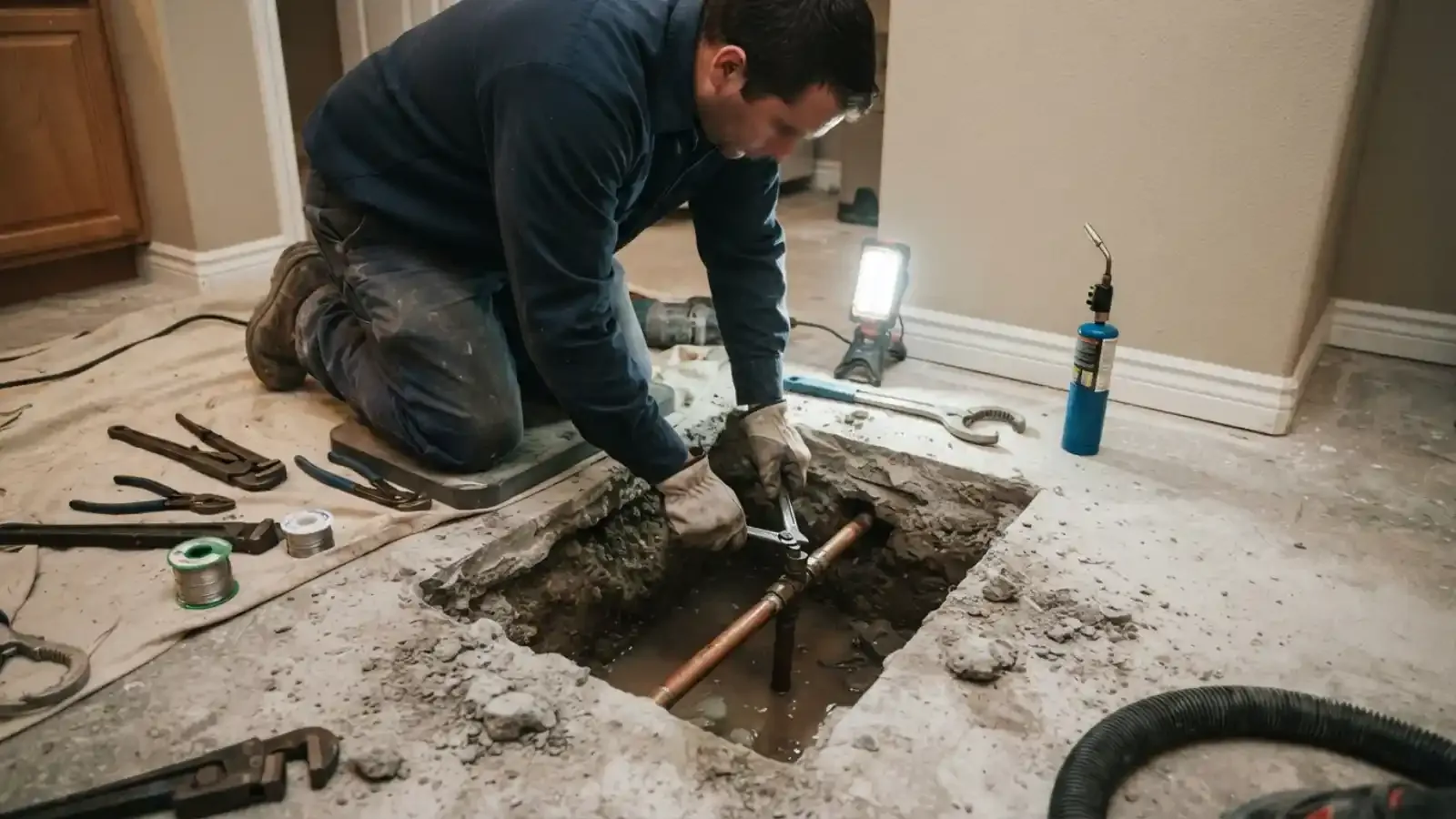
Emergency Slab Leak Repair in Cathedral City, CA
Warm floor spots, a water bill that climbed or the sound of running water at night. Call and we will talk through the options.
If you hear water running with every fixture off, or a spot on the floor is warm to the touch, turn off the main valve and call the 24/7 line. A slab leak is a pipe failure beneath a concrete foundation, and the water can undermine flooring and soil while it runs. While you wait, keep the main off, move belongings off the floor and avoid stepping on warm or damp patches near outlets.
A slab leak is not a DIY job, and it is not always an immediate tear-up either. The first step is finding exactly where the pipe has failed, and the options that follow depend on that location.
What a slab leak looks and sounds like
- Hot spots on a tile or concrete floor, which can mean a hot water line is leaking beneath.
- A water bill that rises without a change in how you use water.
- Sound of water running when nothing is on.
- Cracks in walls or floors, or a damp carpet with no visible source.
- Low water pressure throughout the house.
Not every one of those means a slab leak. A running toilet or a leaking irrigation line can look similar, so we confirm with a meter test and listening tools before recommending work. Our leak detection page covers that first step.
If you suspect a slab leak right now
Do not wait for a stain. A leak under concrete runs out of sight.
- Shut off the main water valve and open a faucet to relieve pressure.
- Avoid warm or damp floor areas near outlets or appliances.
- Move belongings off the floor and lift area rugs.
- Check the water meter to confirm it is not moving after the main is off.
- Photograph wet or cracked areas.
If the meter stops after the main is shut, the leak is on the house side. Tell us that when you call.
Hear water running under the floor?
Call the line. Nights and weekends are covered.
Repair options, from least to most disruptive
| Approach | How it works | Best when |
|---|---|---|
| Spot repair through the slab. | A small opening is cut over the leak and the pipe is repaired. | The leak is one point and access is clear. |
| Reroute the line. | A new line is run through the walls or attic, bypassing the slab. | The pipe has multiple failures or access is difficult. |
| Pipe lining or epoxy. | A coating is applied inside the existing pipe. | Pipe material and condition suit it. |
| Repiping | Replace the affected supply lines throughout the home. | Older plumbing keeps failing in several places. |
Rerouting is often chosen when pipes under the slab are old or have failed more than once, because it avoids further concrete work. Repiping is discussed on our repiping page. We explain the tradeoffs of each approach for your home before you decide.
Why slabs fail in the Coachella Valley
Soil, heat and water chemistry all play a part. Hard water leaves mineral scale that corrodes metal pipe from the inside, and Coachella Valley Water District reports its Cove communities average about 120 mg/L hardness while Desert Water Agency groundwater averages near 230 mg/L. Copper pipe under a slab can pit over decades in water like that.
The ground matters too. Concrete shifts as soil moves, and a small movement can stress a pipe where it crosses a joint or enters the slab. Pipes in slabs built across different decades use different materials, so the age of your home is a clue to what is under the floor.
Cathedral City was first platted as a subdivision in 1925 and incorporated in 1981, so homes here span many building eras. Ask us about the pipe material when we find the leak, because it affects whether a spot repair will last.
After the repair
Once the pipe is fixed, the slab is patched and the area dried. Water that ran under a slab can leave moisture behind, so we recommend checking flooring and baseboards for damp for several days. If flooring needs replacing, that is a separate trade, though we can tell you where the damage stops.
If your insurance covers the leak, they may want a detection report and photographs. Keep the report from the detection step and ask us for a written summary of the finding and repair.
What slab leak repair costs
Slab leak work spans a wide range because the repair method varies so much. A point repair is a smaller job, and rerouting or repiping is a larger one.
What moves the price
Many policies cover resulting water damage and sometimes the access needed to reach the pipe, but not the repair of the pipe itself. Ask your agent before work starts.
For your real number, call (760) 986-1999 and describe the problem.
Questions about slab leak repair in Cathedral City
Yes. The line is open 24/7, including nights and weekends. Shut off the main valve, call, and we will talk you through what to do. After-hours visits begin with locating the leak.
No. Depending on where the pipe has failed, a plumber may reroute the line through walls or the attic instead. We describe the options for your home and the likely mess and cost of each.
We confirm the leak with a meter test, then use acoustic listening and thermal tools to pinpoint it. A locator marks the spot on the floor. The goal is the smallest possible opening.
Over time, yes. Water can wash away soil under the slab and cause settling or cracking. Fast diagnosis limits that risk. If you see new cracks, mention them when you call.
If supply lines have failed repeatedly or are an older material, repiping may be worth considering. See our repiping page for what is involved.
Stop the leak under your floor
Call to talk through the problem and the price before any concrete is cut.
Call (760) 986-1999