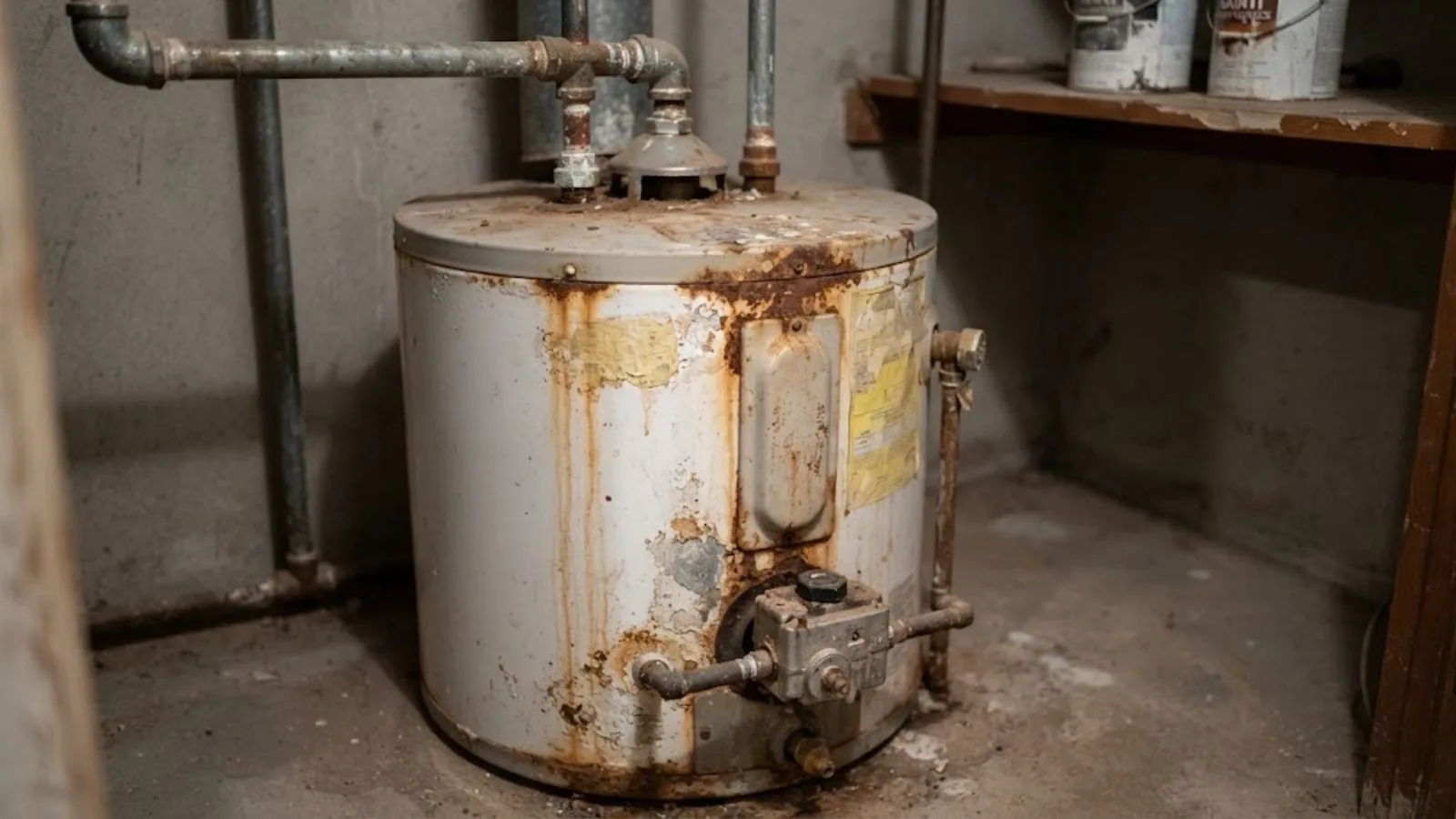
If your water heater is leaking, shut off the cold water supply to the tank and switch off the gas or the breaker, then work out where the water is coming from. A leak from a valve or a fitting can often be repaired. A leak from the tank body means the steel has failed and the heater has to be replaced.
This guide covers the first ten minutes, how to read the leak, what each source means and when to call. If you ever smell gas, leave the house first, and do not touch the heater.
The first ten minutes
Cut the supply
Close the cold water valve above the tank, which is usually a lever or a round handle on the pipe going in.
Turn off the fuel
Set a gas heater control to off, or switch off the breaker for an electric unit.
Relieve the pressure
Open a hot tap in the house so the system does not push water out of the leak.
Contain the water
Mop up, move belongings and put a pan or towels around the base.
Do not drain a hot tank without letting it cool. Water from the tank can scald, and the relief valve discharge pipe can run very hot.
Where the water is coming from
| Source | Usually means | Repair or replace |
|---|---|---|
| Pipe fittings on top. | A loose or corroded connection. | Repair |
| Relief valve or its discharge pipe. | High pressure or temperature, or a worn valve. | Repair, but find the cause. |
| Drain valve near the bottom. | A worn valve or washer. | Repair |
| Water pooling under the tank. | Often the tank itself. | Replace, if the tank is the source. |
| Condensation on the tank or pipes. | Humidity, not a leak. | Usually nothing to fix. |
It can be hard to see the source with the tank insulated. If you cannot find a leak at a fitting and water keeps appearing at the base, assume the tank is leaking.
Water pooling at the base?
Call the 24/7 line.
Gas safety
A gas heater has a flame or pilot, and water on the burner can put it out or damage it. If you smell gas, do not operate switches or phones in the house. SoCalGas says to leave the area immediately, call 1-800-427-2200 from outside and call 911 if there is danger.
Never try to relight a pilot after a leak without checking that the unit is dry and that there is no gas smell. When in doubt, call.
Local note: strapping, permits and hard water
California Health and Safety Code section 19211 requires new and replacement water heaters to be braced, anchored or strapped, following the California Plumbing Code. If you replace the leaking tank, the new one must be strapped.
Cathedral City Building and Safety requires permits for plumbing and mechanical installations or alterations, and does not name water heaters on its permit page. Call 760-770-0340 to confirm what a replacement needs.
Hard water shortens tank life. The Coachella Valley Water District 2024 summary reports its Cove communities averaging about 120 mg/L, and the Desert Water Agency 2021 report shows groundwater near 230 mg/L. A leaking tank in a house that has never had a flush is common here.
Repair or replace
A fitting or valve leak on a younger tank is a reasonable repair. A tank that leaks from the body, an old tank with rust-colored water or one that has already had repairs is a replacement. Our water heater repair page covers the repairs, and water heater replacement covers the swap.
If you are in Palm Springs, you can reach the same team through our Palm Springs plumbing page. For both cities the first steps are identical, and the line is open 24/7.
The relief valve explained
The temperature and pressure relief valve is a safety device. It opens if the tank gets too hot or the pressure climbs too high, and it sends water down a discharge pipe. If you see water at that pipe, the valve has opened or it is leaking.
A brief discharge during a heating cycle can happen with some systems, and constant dripping is a sign of a problem. Possible causes include thermal expansion in a closed system, high supply pressure or a worn valve. A plumber measures the pressure before replacing the valve, because a new valve will leak too if the pressure is the cause.
Never cap or plug the discharge pipe. The valve is there to stop a dangerous buildup.
Protect the space around the heater
- Place a drain pan under the heater if the space is finished or has stored items.
- Keep boxes and chemicals away from the base.
- Know where the cold water shutoff is and that it moves.
- Test the shutoff once a year so it does not seize.
- Check the unit for dampness after any heavy hot water use.
A pan with a drain line carries small leaks outside, which buys time. A heater inside a living area deserves a water sensor, which gives an early alert.
After the repair or replacement
Once the leak is fixed, watch the area for a few days. Dry the floor, check the base each morning and look at the relief valve discharge pipe. If you replaced the tank, ask the plumber to show you the shutoff valves and the temperature setting.
Set the temperature on the lower end of what you need. Hotter water increases scald risk and speeds up scale buildup. Mark the date of the install on the tank, which helps you plan a flush and a check later.
Quick questions
No. A leak can get worse without warning. Shut it off until a plumber has looked at it.
The valve opens when pressure or temperature is too high. It can also be worn and leaking. Find the cause before replacing the valve.
Condensation can form on cold pipes and tanks in humid conditions. It is usually small and dries up.
Yes. California Health and Safety Code section 19211 requires new and replacement water heaters to be braced, anchored or strapped.
Leave the house and call SoCalGas at 1-800-427-2200 from outside. Call 911 if there is danger.