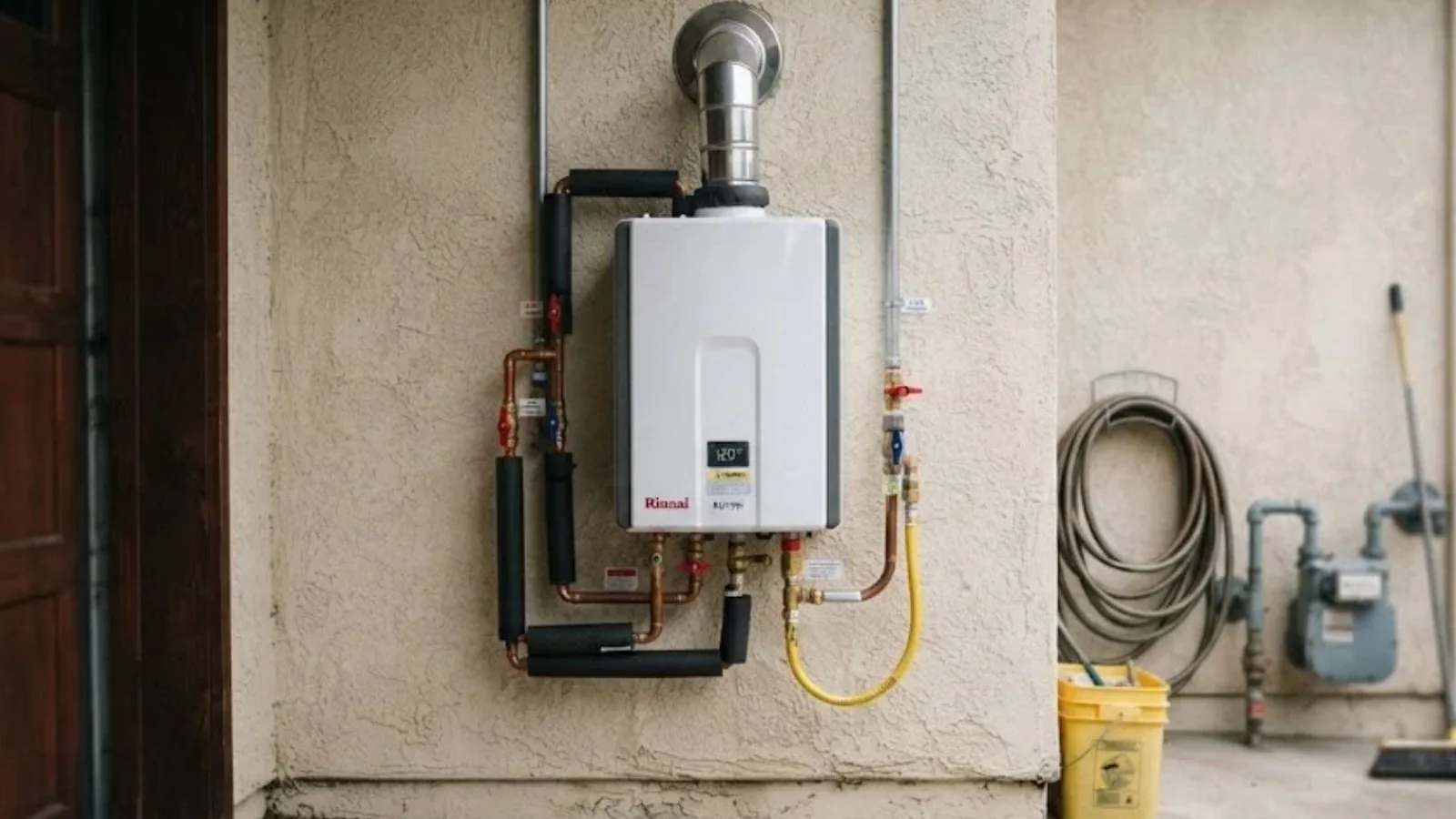
A tankless water heater has requirements a tank does not: a larger gas supply or heavy electrical circuit, a special vent, a way to drain condensate, enough water flow and a plan for descaling. If your home meets those, a tankless unit can work well. If not, the upgrades can add real cost.
This checklist is the same one we use before we quote. Use it to find out where your home stands before you order a unit. It does not state code rules from memory, and it points you to the city for the rest.
The requirements at a glance
| Requirement | Why it matters | How to check |
|---|---|---|
| Gas supply. | The burner fires at high output all at once. | Ask a plumber to check the line and meter capacity. |
| Electric supply. | Electric units draw a heavy load, and gas units need power for controls. | Check panel capacity and outlet. |
| Vent | Exhaust must go outside by an approved path. | Follow the manufacturer's vent types and limits. |
| Condensate drain. | High-efficiency units produce acidic water that must drain. | Plan a drain path. |
| Water flow. | Output depends on flow and temperature rise. | Size to peak demand. |
| Service access. | Descaling needs service valves. | Install isolation valves. |
Gas and electric supply
A gas tankless unit needs a gas line sized for its full burn rate, and a line that fed a tank may be too small. A longer run with more fittings reduces flow, so the length matters, not just the diameter. We measure and calculate the line before quoting, and we may recommend a larger line.
An electric tankless unit draws a heavy current, and many homes cannot carry it without a panel upgrade. If your panel is full, the electrician's work is a separate cost. Gas units also need a small outlet for controls and fans.
Want a quote?
Call for a tankless install quote.
Venting and condensate
Exhaust has to travel to the outside, and the allowed vent material, length and number of turns are set by the manufacturer. A short, direct route is easiest. High-efficiency condensing units make acidic condensate that must go to a drain, and sometimes a neutralizer.
These choices decide where the unit can sit, so read the manufacturer's instructions before you commit to a spot.
Local note: hard water and permits
Hard water is the local requirement people forget. The Coachella Valley Water District 2024 Domestic Water Quality Summary reports its Cove communities averaging about 120 mg/L with a range from 8.4 to 310, and the Desert Water Agency 2021 report shows groundwater averaging near 230 mg/L. A tankless heat exchanger scales in water like that, so plan on service valves and regular descaling.
Cathedral City Building and Safety says permits are required for plumbing, electrical, sewage and mechanical installations or alterations. Tankless installs touch several of those, so call 760-770-0340 and ask what applies. Inspections run Monday through Thursday.
When a tank is the better answer
If the gas line cannot support a tankless unit, the vent path is long and difficult or the panel cannot take an electric unit, a tank may be the better and cheaper choice. A hybrid heat pump is another option where there is space. Our water heater replacement page compares them.
For help planning, see tankless water heater. If you live in Palm Springs, our Palm Springs plumbing page lists what differs there.
Flow rate and temperature rise
A tankless unit is rated by how many gallons per minute it can heat to a given temperature rise. Temperature rise is the difference between the incoming cold water and the hot water you want. Colder incoming water means a smaller flow from the same unit.
To size one, add up the fixtures you might run at the same time, such as a shower and a dishwasher, and compare that total flow to the unit rating at your temperature rise. A unit that is too small gives lukewarm water when two fixtures run.
Ask the installer to show the numbers for your house. A sizing answer that is just the name of a model is not a calculation.
A maintenance plan before you buy
- Install isolation valves so the heat exchanger can be flushed.
- Plan a flush with descaling solution on a schedule that suits your water.
- Clean the inlet screen when you flush the unit.
- Check the vent and the condensate drain each year.
- Keep the manual and the model number where you can find them.
A tankless unit that is flushed on schedule is likely to hold its performance. One that is never flushed may lose flow slowly, and then fail early. Our tankless water heater page covers service.
Warranty and paperwork
Tankless warranties often depend on installation by a licensed contractor and on regular maintenance. Some manufacturers ask for proof of descaling in hard water areas. Read the warranty before you buy, and keep service records in the same folder as the receipt.
Ask the installer to register the unit, or do it yourself, and note the serial number. If a problem appears in year three, you will want the paperwork in one place.
Quick questions
Maybe not. Tankless units draw more gas at once. A plumber should check the line size and run length.
Gas units do. The vent type and path are set by the manufacturer, and the city enforces code on installation.
High-efficiency units produce acidic water as they cool exhaust. It has to drain, and it may need a neutralizer.
Warranty terms vary by manufacturer. Many require regular descaling in hard water, so read the terms before you buy.
The city lists permits for plumbing, electrical and mechanical installations. Call Building and Safety at 760-770-0340 and describe the job.
Know the requirements before you buy
Call to ask about pricing on a tankless install.
Call (760) 986-1999